Mobile data backup for the set

Back up memory cards on iPad.
Verified. No laptop.

Offloadr copies your footage from memory card or photo library to SSD and NAS – as fast as your hardware allows. Every file is hashed, verified individually and written through all the way down to the drive: "SECURED" only appears once everything truly checks out. Right on your iPhone and iPad.

Version 3.0 Projects with stored destinations · shoot-day counter · history by project · clear failure screen See what's new

€4.99 once · no subscription · iPhone, iPad and Mac

up to ~1 GB/sNVMe SSD on iPad Pro (USB 3)
xxHash-64 · SHA-256verified per ASC MHL v2
0cloud, tracking, accounts
ascmhl with chain – compatible with YoYotta Hedge / OffShoot Silverstack Lab Pomfort
Who is behind it

Built on a dive boat, not at a desk

Daniel Kainz at work behind the camera
Daniel Kainz

Offloadr exists because I wanted my own videos and photos safely backed up on diving trips – and had had enough of pushing files around in Finder on the iPad. What I needed was a fast, dependable routine that also works on the dive boat or in a hotel room at night. That is where the decisions about what may count as "secured" were made.

I built Offloadr with Claude (Anthropic) as a coding assistant. The requirements, decisions and testing are mine. I'm writing this here because with backup software it shouldn't matter who typed the code – what matters is whether you can check it. You can: every offload is independently verifiable.

What is Offloadr

The offload workflow that fits on an iPad

On set, every minute counts. When the card is full, the footage has to be secured – fast, fully documented and with no anxious moments before formatting. Professional DIT software used to be expensive, desktop-bound or too cumbersome for daily set use. Offloadr puts the complete offload workflow on the device already in your bag – with no compromise on safety or functionality.

Who it's for

Built for everyone who can't afford to lose footage

DITs

Digital Imaging Technicians

Card in, pick destination, start. You end up with a complete handover package of MHL, PDF report and metadata export – no hunting around, no manual logging.

Solo & camera

Camera operators & solo filmmakers

No laptop setup required: one iPad, one SSD over USB-C – that's your entire mobile backup workflow. On set, in the van, in the hotel room.

Photo / RAW

Photographers with large RAW volumes

Back up DNG, HEIC and JPEG straight from your photo library to NAS or SSD – verified, with metadata export. Back up photos on the go, no laptop needed.

In four steps

Back up a memory card to SSD – how an offload works

01

Pick source

Memory card, USB drive, individual files or straight from the Photos app.

02

Pick destination

External SSD, NAS, SMB network share – optionally a second destination for redundant backup.

03

Start offload

Offloadr copies, hashes and verifies fully automatically. In parallel, with no waiting.

04

Handover

The "SECURED" confirmation, plus MHL, PDF report and metadata export in the destination folder.

What makes Offloadr different

Honest verification. Real speed. Zero admin.

Honesty

"SECURED" only appears when every single file on every destination has been verified. Otherwise it says "NOT SECURED" in red – no sugar-coating, no silently carrying on after errors.

Speed

Direct C-level I/O with double buffering reads your SSD at its limit. Hashing runs in parallel with copying, adding no extra time.

Zero admin

After every offload, Offloadr automatically creates everything for a professional handover: MHL in the ASC standard, PDF report, metadata CSV and a full log – without lifting a finger.

Highlights

The core of Offloadr – and what it's built for

Copy engine

Superfast transfers

Files keep getting bigger, cards and readers faster – the bottleneck must never be the software. Offloadr uses direct POSIX I/O with F_NOCACHE, bypassing the system's RAM cache. Every byte lands straight on the destination.

  • Double buffering: reading, writing and hashing run in parallel
  • The hardware sets the limit, not the app: an iPad Pro with USB 3 reaches around 1 GB/s, while non-Pro iPhones over USB 2 deliver far less. Often the card reader is the bottleneck first
  • Hashing costs no extra time: it runs alongside the copy, not after it
  • The in-app throughput graph makes drops from throttling or a full SLC cache instantly visible

Read speed compared

Reference values from an iPad Pro (USB 3) with an NVMe enclosure. Your numbers depend on device, card reader and drive – non-Pro iPhones over USB 2 are well below this.

Offloadr → NVMe SSD (USB-C)~1,000 MB/s
Offloadr → SATA SSD~520 MB/s
Files app (manual copy)~110 MB/s
Verification, everywhere

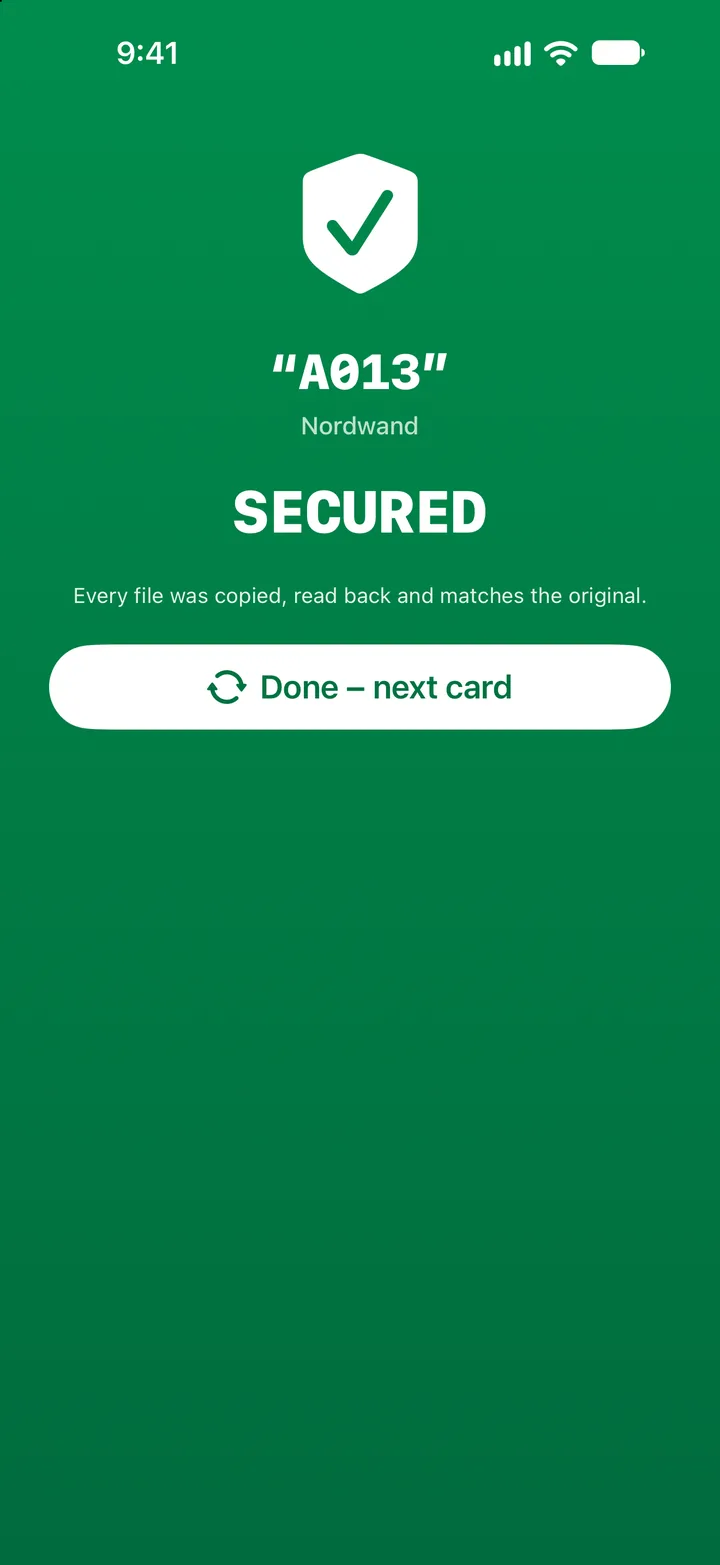
"SECURED" really means safe

After copying, Offloadr re-verifies every single file: the destination file is read back fresh from the destination medium, its checksum computed and matched against the source – no trusting write caches, no shortcuts. Writing through to the medium (F_FULLFSYNC) is not switchable: the data must physically reach the flash cells before a file counts as secured. With two destinations, both checks run at the same time, saving up to 50% verification time.
  • If a checksum doesn't match, the file is flagged as failed
  • Even a single error shows "NOT SECURED" in red instead – with the number of affected files
  • Optional 3-way verification re-reads the source and catches unstable card reads
  • Every history entry automatically gets a proof made of time, device and checksum
  • Dual backup to two destinations, each verified independently
Offloadr on iPhone: green completion screen reading SECURED for card A013
The screen that matters – it only appears once every file has been read back.
Handover package

MHL, PDF report & metadata – automatic

There's no time for admin on set – so Offloadr does it for you. After every offload, everything for a clean handover sits in the destination folder: a full ascmhl folder with numbered generations, directory hashes and a chain file – exactly as Pomfort Silverstack, YoYotta and Hedge expect it.

  • ASC MHL v2: generations, directory hashes and chain – plus a built-in MHL checker
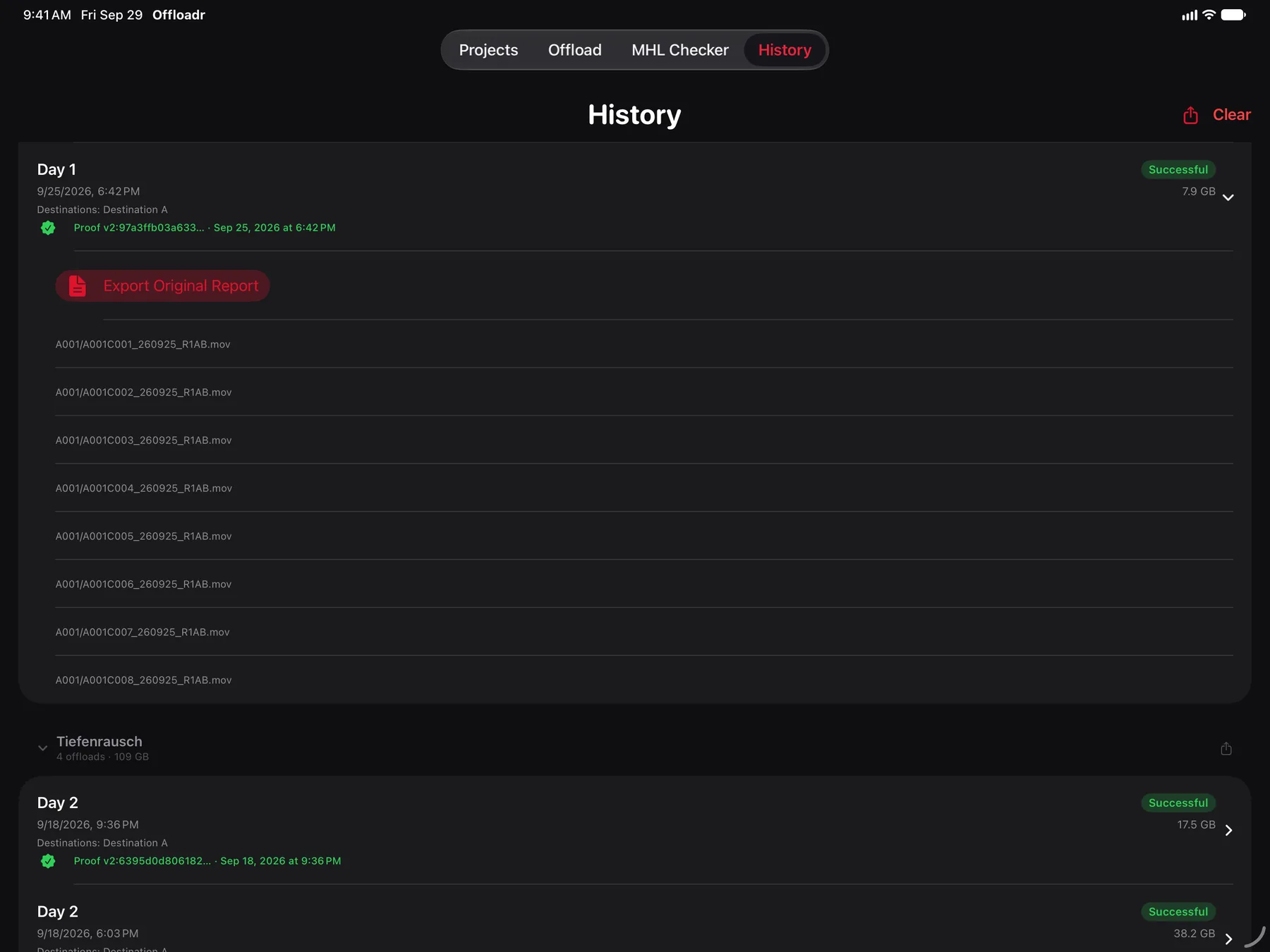
  • PDF report with your logo, clip thumbnails and throughput graph
  • Metadata export as CSV (UTF-8 BOM) and JSON – GPS coordinates can be disabled
  • New: PDF, log and metadata live in the _Offloadr subfolder – next to the clips there are only clips
  • Every export individually configurable – you decide what ends up in the destination folder
PDF report in Offloadr with file list, checksums and throughput graph
The PDF report is created automatically – file list, checksums and throughput over time.
Technical details

ASC MHL v2, hashes & reports – for everyone who wants the specifics

Show technical details

Copy engine

Direct POSIX I/O (open/read/write) with F_NOCACHE. Double buffering: chunk A is written, chunk B read, hash for A computed in parallel.

Hash algorithms

xxHash-64 by default – ASC MHL v2, up to 15–20 GB/s, the same thing Silverstack, Hedge and ShotPut Pro write. SHA-256 hardware-accelerated when a broadcaster or archive requires a cryptographic checksum.

Verification

The destination file is re-read from the medium and compared to the source. F_FULLFSYNC forces the physical write. Optional 3-way verification re-reads the source. Two destinations at once – up to 50% faster.

ascmhl & chain

A full ascmhl folder with numbered generations, directory hashes and a chain file. The built-in MHL checker verifies your own and third-party MHLs against the actual files.

Reports

PDF with clip thumbnails, throughput graph, file list and checksums. Metadata as CSV (UTF-8 BOM) and JSON – GPS coordinates can be disabled, every export individually configurable.

Incremental mode

Compares size and modification date and skips what's already backed up – ideal for interrupted offloads. Copies keep their original timestamps.

Projects

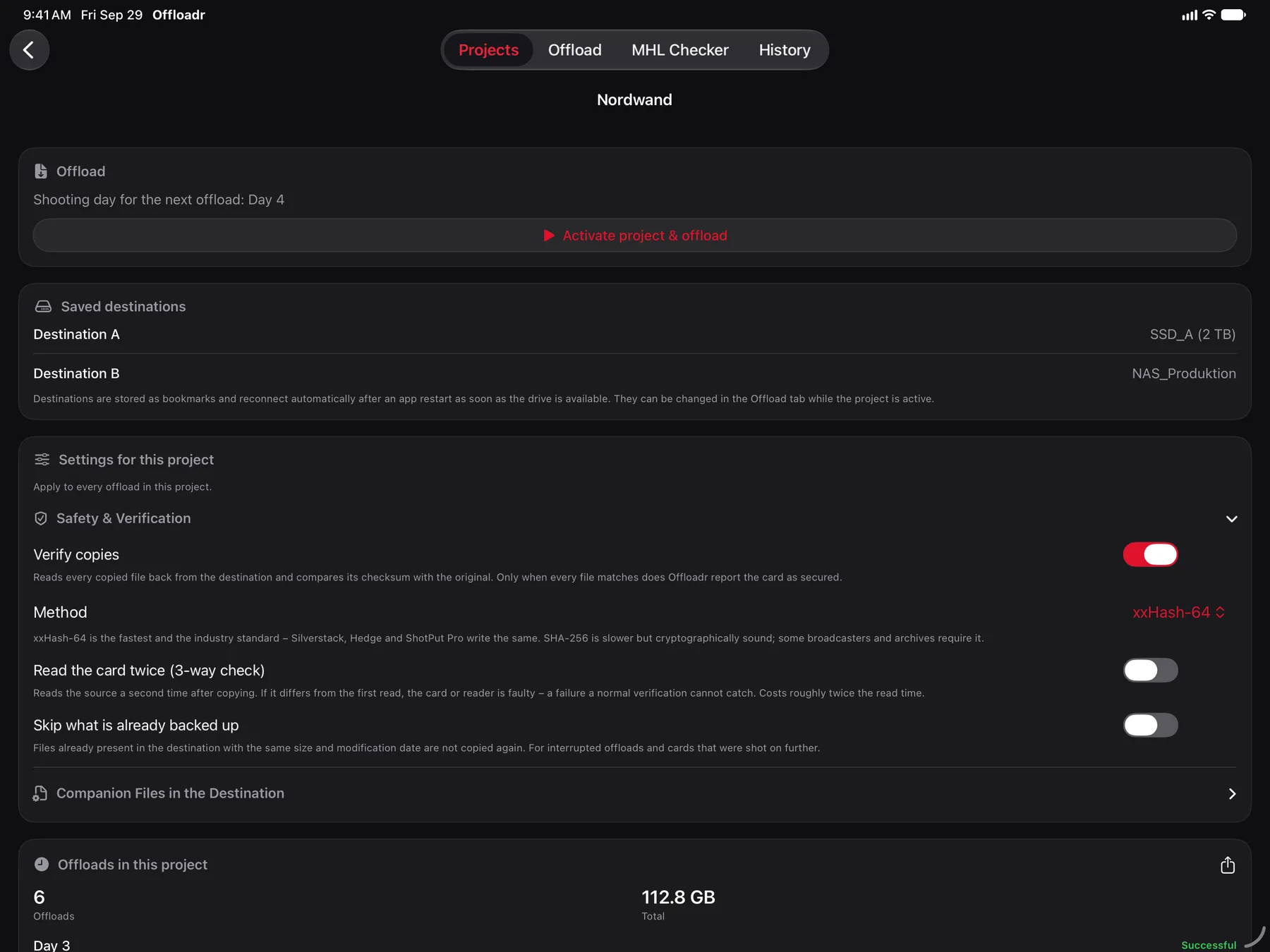
Destinations as security-scoped bookmarks, an options snapshot and a shoot-day counter per production. After an app restart the drives reconnect automatically. History and a combined report per project.

Live Activity

ActivityKit shows project name, progress, data volume and time remaining on the lock screen and in the Dynamic Island – live during the offload.

Network (SMB/NAS)

Any SMB share mounted via the Files app: Synology, QNAP, TrueNAS, Windows. Connection drops are detected instantly and logged.

Photos integration

Apple's PHPicker – privacy-friendly, without full library access. iCloud photos are downloaded automatically when needed.

Background & alerts

The display stays awake during an offload so the device won't lock itself. Notifications report errors clearly – no more "success" when something went wrong.

Requirements

iOS, iPadOS or macOS 26.0 or later – iPhone, iPad and Mac. External hardware: any USB-C compatible SSD or SMB share. Internet only needed for NAS destinations and iCloud photo downloads.

CategorySupported formats
VideoMOV, MP4, MXF, M4V, AVI, MKV – via AVFoundation
RAW videoR3D, ARRIRAW (.ari), Blackmagic RAW (.braw) – backed up & hashed
Photo / RAWDNG, CR2, CR3, NEF, ARW, RAF, RW2, HEIC, JPEG, TIFF
OtherAll file types are copied & hashed
New in version 3.0

Set up once, use it for the whole shoot

From the second offload onwards nothing is new – yet everything had to be set up by hand every time. Projects remember what stays the same. Plus a result screen that shows failures just as clearly as successes.

New

Projects

Set destination drives, verification method, companion files and shoot day once. On the next offload everything is already there – all that's missing is the card.

New

Drives reconnect themselves

A project's destinations are stored as bookmarks. After an app restart they are connected again as soon as the SSD is plugged in or the NAS share is reachable – no hunting through the Files dialog.

New

Shoot day counts along

"Day 3" becomes "Day 4" on the next offload – leading zeros are preserved. The folder structure in the destination stays right without anyone having to think about it.

New

Failures as clear as successes

When verification fails, a red full-screen notice appears with the number of affected files and a direct route into the log. The very case where the card must not be erased used to get the least attention.

New

Write-through is mandatory

Writing through to the medium (F_FULLFSYNC) can no longer be switched off – the reason is above.

New

History by project

Collapsible sections per production, chronological within, with count, total size and a combined PDF. Anything backed up without a project gets its own section.

Also improved

Small things that make set days easier

  • Every setting explains in plain language what it does and what it costs
  • PDF report, log and metadata live in the _Offloadr subfolder – next to the clips there are only clips
  • Source and destinations can be cleared individually – selections used to accumulate unnoticed
  • MHL Checker now explains what it is for
  • Layout fixes on iPhone and iPad, numerous stability improvements
Project view in Offloadr with saved destination drives, verification method and shoot day
A project remembers destinations, verification method and shoot day – next time all that's missing is the card.
Privacy

No data, no cloud, no surprises

Offloadr was built from day one on a clear principle: what's shot on set stays on your devices. No account, no login, no tracking.

No data transfer to external servers. Offloadr runs completely offline.

No tracking, no ads, no user profiles, no analysis of your behaviour.

No account, no registration, no login. Just install and go.

Only necessary permissions via Apple's Security-Scoped Resources and PHPicker. Full Privacy Manifest.

Note: these points describe the Offloadr app. This website itself uses Google Analytics only with your explicit consent (Google Consent Mode v2, off by default). See the privacy policy for details.

FAQ

Frequently asked questions

Does Offloadr's mobile backup work offline without an internet connection?
Completely. Offloadr runs offline and never needs an internet connection – except when you want to download photos from iCloud or use a NAS destination over your local network.
Which memory cards (CFexpress, SD, CFast) can Offloadr read on iPad?
Any card the iPad recognises as a file system – CFexpress, SD (via adapter), USB-C card readers and more. Offloadr sees the content as a folder structure. You can also pick individual folders or files.
Can I back up a memory card to two destinations (SSD & NAS) at once?
Yes. Offloadr supports dual backup: a mandatory destination A and an optional destination B. Both are written simultaneously and then verified independently. Only when both match does Offloadr report the card as secured.
When does Offloadr report a card as secured?
The green "SECURED" screen appears only once every single file has been copied, read back from the destination and its checksum matched against the original with no deviation. On top of that Offloadr forces every file to physically reach the drive's flash cells before it counts as secured (F_FULLFSYNC) – not switchable. If even one file fails, a red "NOT SECURED" screen appears instead, with the number of affected files and the instruction not to erase the card.
Which hash algorithms does Offloadr support?
xxHash-64 by default and SHA-256. xxHash-64 is part of ASC MHL v2 and the same thing Pomfort Silverstack, Hedge and ShotPut Pro write – third-party tools can verify the MHL without asking questions. SHA-256 runs hardware-accelerated on Apple Silicon and delivers a cryptographically sound checksum; some broadcasters and archives require it. MHL files from other programs using xxHash3-128 can still be verified in MHL Checker.
Does Offloadr write a full ascmhl structure with generations and a chain?
Yes. Offloadr creates a full ascmhl folder: numbered generations, directory hashes and a chain file that cryptographically links every generation. That's exactly what Pomfort Silverstack, YoYotta and Hedge expect. The built-in MHL checker verifies your own and third-party MHL files against the actual files on the drive.
What do projects do in Offloadr?
A project holds on to what doesn't change over a shoot: the destination drives, the verification method, which companion files get written and the shoot day. The drives are stored as bookmarks and reconnect automatically after an app restart as soon as the SSD is plugged in. The shoot day counts up on its own and history is grouped by project. If you just want to back up one card quickly, you can still work without a project.
How do I prove later that a backup is unchanged?
Every history entry automatically receives a proof made of the time, the device model and a HMAC-SHA-256 signature covering the complete entry – including status and file list. The key lives in the device's Keychain and never leaves it. If the entry is modified afterwards the signature no longer matches and Offloadr flags it – in history and in the PDF report. On top of that you can re-verify the backup on the drive at any time with MHL Checker against the checksums from back then.
Can I resume an interrupted offload?
Yes. In incremental mode Offloadr compares file size and modification date and skips everything that has already been backed up. An interrupted offload can simply be started again without copying the whole card a second time. Copies keep their original timestamps.
Does Offloadr support RAW formats like R3D, ARRIRAW and Blackmagic RAW?
Offloadr copies and hashes all file types – including R3D, ARRIRAW (.ari) and Blackmagic RAW (.braw). They are fully backed up and verified. Technical metadata (codec, frame rate, camera model) can't be read for these formats, as that requires vendor-specific SDKs.
Can I back up iPhone photos on the go without a laptop?
Yes. The built-in Photos integration lets you pick straight from your library – photos, videos, DNG RAWs, ProRes. Offloadr backs up the original files (not compressed previews) to your destination. iCloud photos are downloaded automatically on export.
Which NAS systems (Synology, QNAP, TrueNAS) are supported for offloads?
Any NAS or network share that can be mounted as an SMB share via Apple's Files app: Synology, QNAP, TrueNAS, Windows shares and many more. Connect once in the Files app – then the drive is permanently available in Offloadr.
Does the offload keep running when the iPad is locked?
No – and that's a deliberate iOS limit, not an oversight. While an offload runs, Offloadr keeps the display awake so the device won't lock itself; the Live Activity shows progress on the lock screen and in the Dynamic Island. But if you lock the device by hand or leave the app, the system grants only a few seconds of grace and the job then pauses. So keep Offloadr in the foreground and on power while it secures a card.
Was Offloadr built with AI?
Yes. Offloadr started out for my own diving trips – built with Claude (Anthropic) as a coding assistant. The requirements, decisions and testing are mine. More important than who typed the code: you don't have to take anyone's word for it. Every offload writes an ASC MHL v2 hash list. With the default algorithm xxHash-64 you can re-check it independently using the official ascmhl tool – file checksums, directory hashes and root hash all match there. (If you pick SHA-256 you'll need a different checking tool: ascmhl does not support SHA-256.)

Ready for Offloadr?

Back up your footage, verified, to SSD and NAS – with hash verification, ASC MHL v2 and everything a clean handover needs.